From First Gateway to a Hundred: Launching a LoRaWAN Operator Network
A Network Is Built Twice
Every LoRaWAN operator builds its network twice. The first time is the radio network: gateways on rooftops and masts, antennas, backhaul, coverage. The second is everything that lets the first one be sold: onboarding customers, supporting their devices, fixing gateways nobody can physically reach, and proving that the coverage on the map is the coverage in the street.
The first network gets all the attention, because it is visible and because it is where the money goes. The second one decides whether the operator grows.
Plan the hundredth gateway on the day you install the first. Every habit you take with one gateway, naming, photos, remote access, onboarding steps, either scales to a hundred or becomes the thing you have to fix at fifty.
This is the playbook I follow with operators building a network, in the order the problems actually arrive.
Coverage You Can Prove
Start with where the customers are, not where the rooftops are. An operator network is a commercial asset; the first gateways belong where the first contracts are likely, an industrial zone, a port, a utility's service area, and the rest of the map follows demand.
Then plan the sites properly. Height matters more than anything else, a principle the range assessment article puts numbers on, and a gateway ten meters higher with an ordinary antenna beats an expensive antenna on a low roof. Check the feeder, the lightning protection and, near cellular sites, the RF noise before you commit, because each of those has quietly ruined good locations.
Finally, measure what you built. A coverage map drawn from a propagation model is a promise; a map built from real uplinks received by your gateways is evidence. The operator platform I run computes coverage on an H3 hexagonal grid from actual traffic, which is the map worth showing a prospect, and the one that tells you where the next gateway should go.
Gateways You Can Always Reach
Choose gateways for the site, not the catalogue. A sealed industrial unit such as the Kerlink iStation earns its price on a mast you can only reach with a crane; a light outdoor gateway like the Wifx L1 is the better answer where weight and solar power are the constraints. Prefer models that speak both the Semtech UDP packet forwarder and Basics Station, so the protocol choice stays yours.
Then solve remote access before the tenth installation, not after. Gateways end up behind 4G routers, carrier-grade NAT and building firewalls you do not control. Each one should connect out to a VPN you run, so it can be reached by SSH and its web interface from anywhere, and the gateway onboarding article explains why I use OpenVPN with a hostname for it. Segment the access: your support reaches everything, field teams and partners reach the gateways only, gateways never reach each other.
And record every installation the same way: a consistent name, the EUI, the GPS position taken on site, a photo of the installed station and a photo of its label. It takes two minutes with a phone and saves hours the first time someone has to find, identify or replace a gateway they did not install.
Customers Onboarded Without Engineering Work
An operator's customers bring their own devices, and each customer must manage theirs without seeing anyone else's. ChirpStack handles this with tenants: each customer gets an account on the network server, scoped to their own applications and devices, with their data delivered over MQTT or HTTP to whatever system they use.
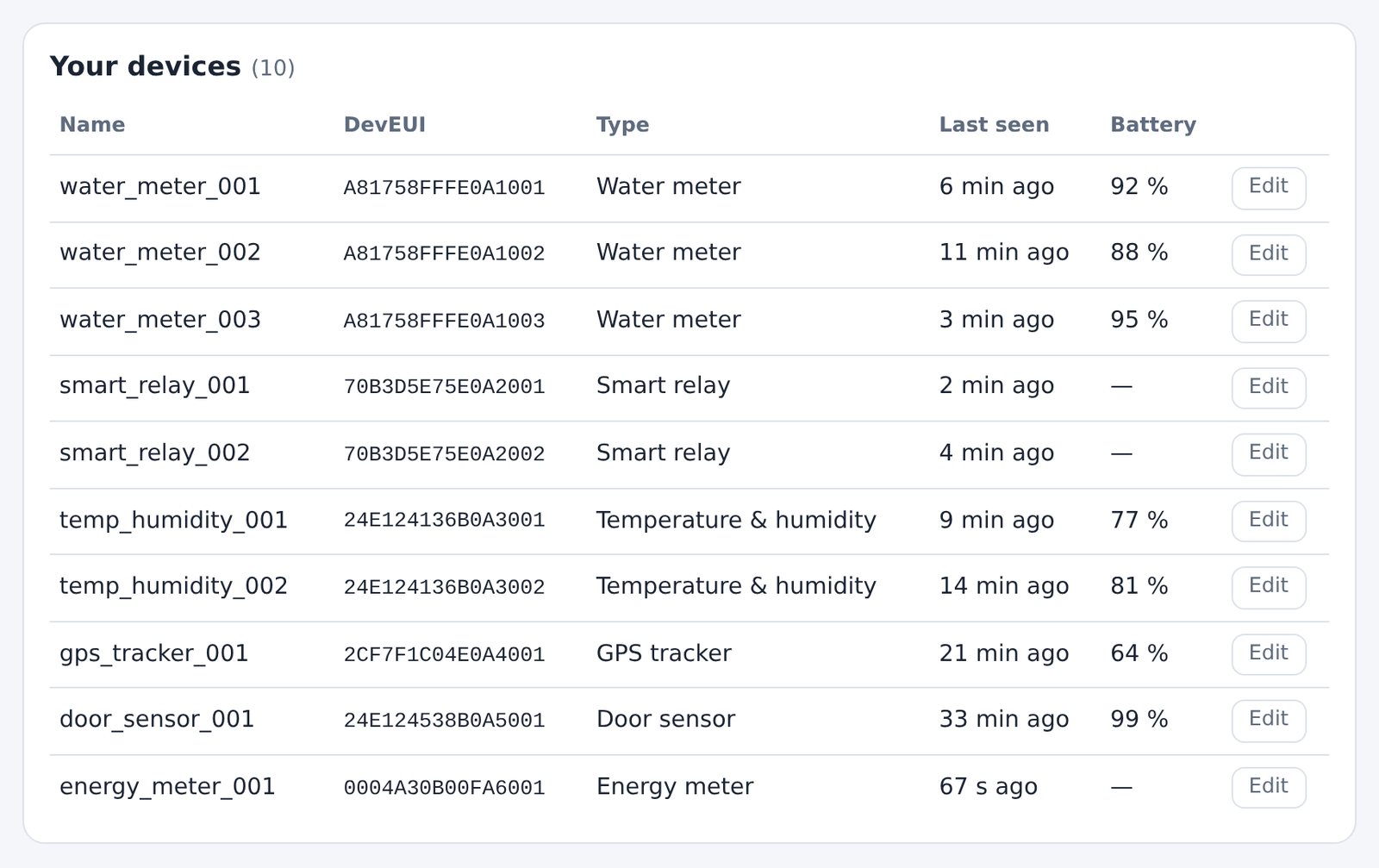
The work that remains is the device side, and it is where networks stall. Every new model needs its keys handled correctly, a device profile that matches its LoRaWAN version and class, and a payload decoder. The device that won't join is almost always a key or a profile, and the device that joins but shows no data is almost always a decoder.
So build the habits early. Keep a library of decoders and treat a new sensor model as a small, routine task rather than a project. Keep raw uplinks, so a decoder fixed next week still recovers this week's readings. Give the operations team a way to add devices and send commands without touching the network server's internals, and keep the commands that work in a catalogue per device type. And help customers choose devices before they buy them, because a device chosen for the use case and tested on site avoids most of the support requests that would otherwise follow.
Support That Scales With the Network
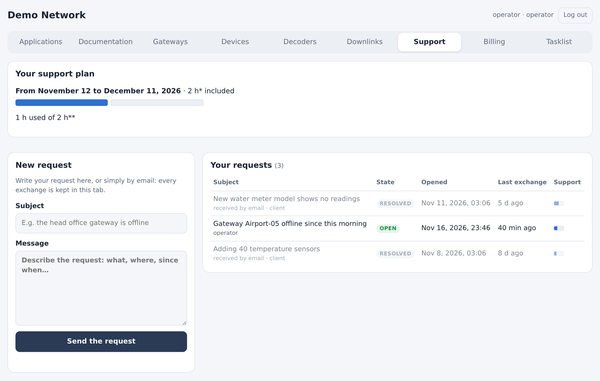
Support for an operator is two layers: your customers ask you, and you need someone to ask. Both have to be fast, and both have to be visible.
Track every request somewhere both sides can see it, with what was done and how long it took. Keep a shared list of what is being worked on and what is next. It sounds like administration; in practice it is what keeps a growing network from depending on one person's memory and inbox.
Watch the network rather than waiting for customers to report it. A gateway that goes quiet, a broker that stops, a disk that fills: all of these should reach you before they reach a customer. A traffic analyzer on top shows what no network server shows, every other operator on your spectrum and every one of your devices that has started to drift.
The Platform Behind It
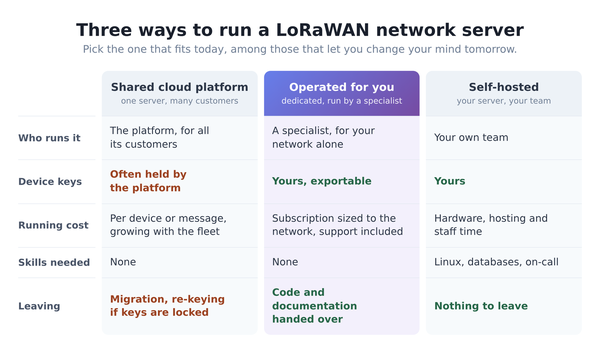
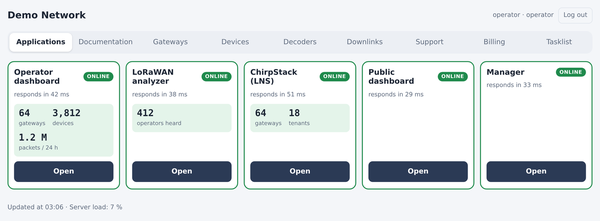
Everything above needs software: a network server, a data pipeline, decoders, dashboards, gateway VPN, customer accounts, backups, monitoring. An operator can build that team, or start on a platform that already does it.
That platform is what I provide as a dedicated operator platform, hosted and operated for you, on standard open source components with a written path to self-hosting. The hosted or self-hosted article sets out when each model makes sense. The short version is that an operator's scarce resource in the first two years is attention, and the network server is the last place it should go.
Growing Past a Hundred
By a hundred gateways the network has a shape. Coverage is dense where customers are and thin where they are not. Capacity starts to matter in the busiest cells, and gateway capacity and duty cycle stop being theory. New questions arrive: carrying a customer's private network server on your gateways, joining a community network, roaming. A multiplexer lets the same gateways serve several network servers at once, which answers most of them without new hardware.
This is also the point to revisit the platform decision. Some operators stay operated; others bring the network server in-house with a team trained to run it. Either is fine, provided the keys, the data and the gateways were free to move from the start.
What I Provide
I help operators launch and grow LoRaWAN networks: coverage planning and site surveys, gateway selection and installation standards, remote access over a dedicated VPN, customer onboarding on their own network server accounts, decoders for every device they bring, and support that is tracked and visible.
The operator platform carries all of it, hosted and run for you with monitoring, backups and an availability commitment, with consulting and training around it for the team that will take the network further.
Working on a LoRaWAN project?
If this article touches on something you're building, tell me about it. The first conversation is free, and you'll get an honest read on the right approach for your situation.
Book a Free ConsultationCurious what the finished thing looks like? Open the live demo dashboard