LoRaWAN Support Contracts: Someone to Call When the Network Misbehaves
The Work Starts After Go-Live
Most of the effort in a LoRaWAN project goes into the launch: choosing devices, placing gateways, standing up the network server, building the dashboards. Then the network goes live, the project team moves on, and the real life of the system begins.
That life is made of small events. A gateway on a roof stops reporting after a storm. A customer buys a batch of sensors from a manufacturer nobody has decoded before. A device that worked for a year starts rejoining every night. A firmware update shifts a byte in a payload and a dashboard quietly shows nonsense. None of these is a crisis on its own, but each one needs someone who knows the network, has access to it, and can tell in ten minutes what would take a newcomer a day.
A support contract buys you that person: someone who already knows your gateways, your devices and your server, with the access to act, a monthly allowance of hours, and a written record of what each hour was spent on.
What a Support Contract Covers
Every contract includes a number of support hours each month, sized to the network: a few hours for a site with a handful of gateways, more for an operator with hundreds. They cover the everyday requests that keep a network healthy:
- a gateway that will not connect, has gone offline, or needs its packet forwarder changed;
- a device that will not join, joins but shows no data, or drains its battery too fast;
- a payload decoder for a new device model, written, tested on real frames and put in place, with past readings recovered where the raw uplinks were kept;
- downlink commands for a device type, worked out once and kept in a catalogue so your team can send them again;
- configuration changes on the network server: device profiles, frequency plans, integrations, new tenants for your customers;
- questions from your team or your own customers, answered in writing so the answer stays useful.
Requests come in the way that suits you: by email, or written directly in your portal. Either way they land in the same place and are followed through to the end.
Every Hour Accounted For
Support contracts have a reputation for opacity: a monthly fee, a vague feeling that something was done, and an argument when the hours run out. Mine work the other way.
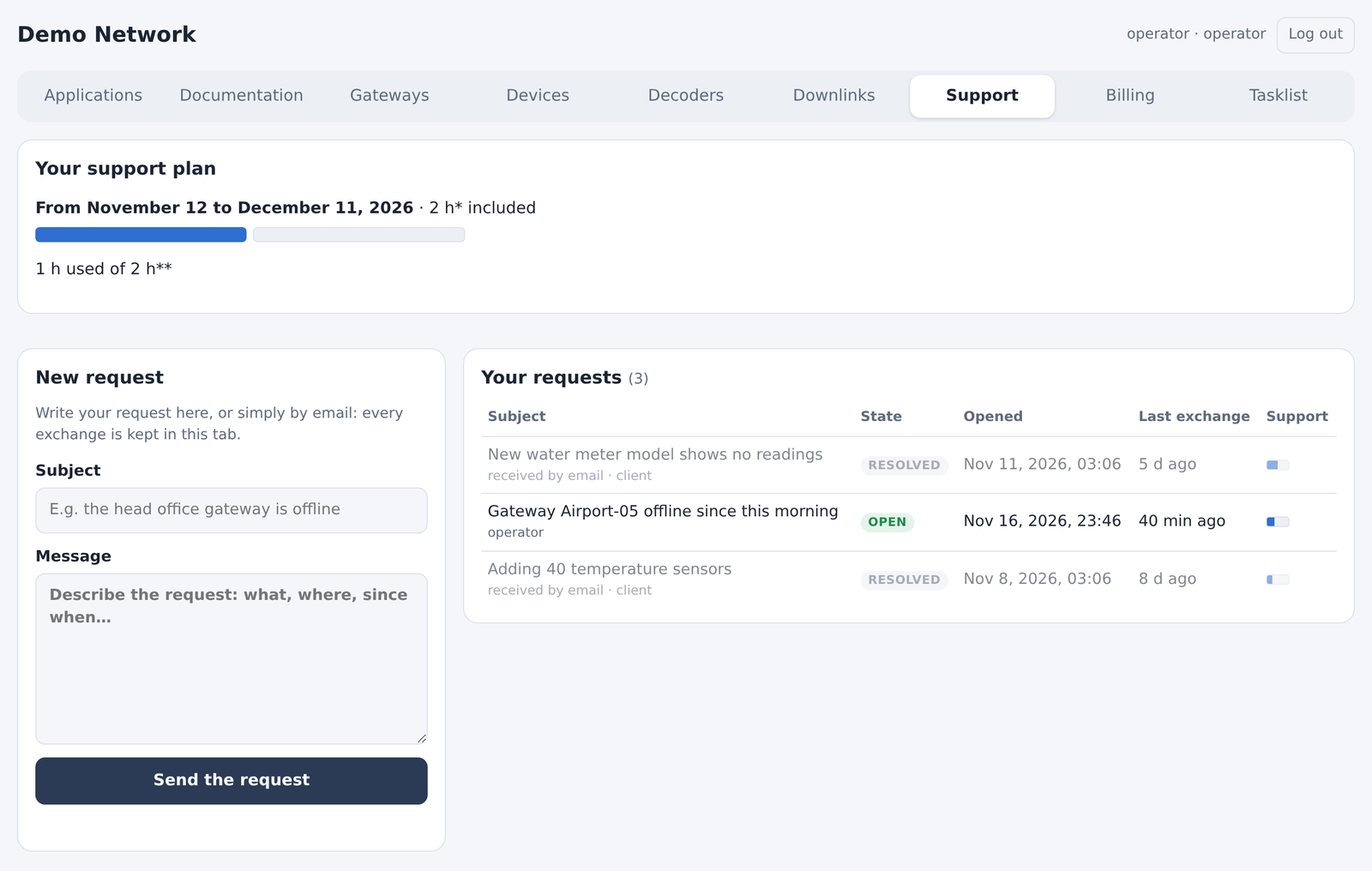
Each request has its own page in your portal with the whole exchange, what was done, and the time spent, written against the request. The hours of the month are shown as a simple bar you can check at any moment. Time is counted as it would have taken to do the work by hand, not inflated, and a short answer counts as a short answer. If a month needs more than the allowance, the overage is visible before it reaches an invoice, and any part of a billed block that was not used stays yours.
The same portal keeps a shared task list: what is being worked on, what comes next, what was done since the start. Nothing about your network lives only in someone's inbox.
Access That Makes Support Fast
Most of the time lost in support is lost getting access: asking someone on site to open a port, waiting for a VPN account, reading a screenshot of a configuration page. A support contract sets that up once.
Gateways connect to a VPN dedicated to your network, so each one can be reached for diagnosis and configuration wherever it is installed, behind 4G routers and firewalls included, without opening anything on the local network. The gateway onboarding article explains how. Access is segmented and logged, and the keys are yours to revoke.
With that in place, most requests are handled remotely the same day, and a site visit is reserved for what genuinely needs hands on the hardware.
On Your Stack or on Mine
A support contract works with what you already run. If your network server is ChirpStack, The Things Stack, Actility or another platform, and your gateways and devices come from several manufacturers, that is normal: I work across all of them, which is the point of independent expertise.
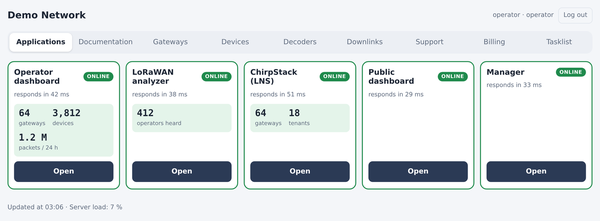
If you run on the operator platform I host and operate, support hours are included in the subscription, along with monitoring, backups and an availability commitment, so the network server itself is never your problem.
And if the goal is for your team to need me less over time, the hours can just as well be spent on training: walking through a gateway installation together, writing the next decoder side by side, or reviewing how your team handled the last incident.
What I Provide
Monthly support contracts for LoRaWAN networks and IoT deployments, sized to the network: support hours included every month, requests by email or in your portal, every request and every minute recorded where you can see it, and overage that is visible before it is billed.
Remote access to your gateways through a dedicated VPN, decoders for the devices your customers bring, downlink catalogues, network server configuration, and answers your team can keep. On your own stack, whatever the vendor, or on the platform I operate for you, with training whenever you want your team to take more of it on.
Working on a LoRaWAN project?
If this article touches on something you're building, tell me about it. The first conversation is free, and you'll get an honest read on the right approach for your situation.
Book a Free ConsultationCurious what the finished thing looks like? Open the live demo dashboard