Hosted or Self-Hosted LoRaWAN Network Server: Choosing Without Getting Trapped
The Question Behind the Question
"Should we host our own network server?" is one of the first questions I am asked by anyone building a LoRaWAN network of real size, and it is usually framed as a technical choice. It mostly is not. Any competent team can install ChirpStack in an afternoon. The hard parts are what happens over the following five years: who keeps it running, who answers when it stops, and what it costs to change course once ten thousand devices depend on it.
Choose the model that fits the stage you are at, but only among the options that leave your device keys, your data and your gateways free to move. The model can change later. Re-provisioning a fleet cannot be undone.
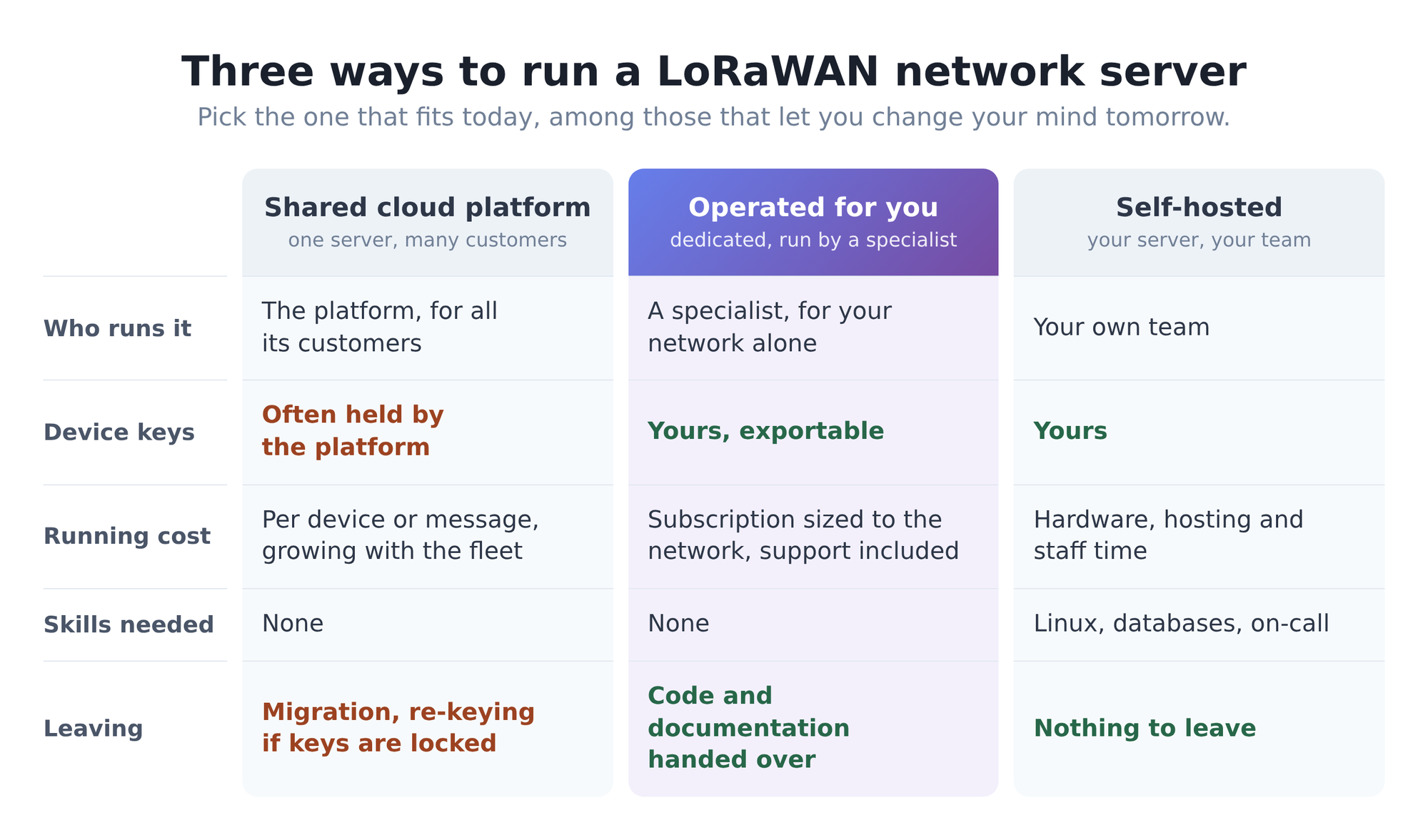
There are three realistic ways to run the network server, and each is the right answer for somebody.
Shared Cloud Platforms
The Things Stack Cloud, Actility ThingPark, Loriot and similar services host your devices on a multi-tenant network server they run for many customers. You sign up, add gateways and devices, and you are live the same day.
For a pilot, a single site, or a company whose business has nothing to do with networks, that is a perfectly good answer. Nobody on your side needs to know what Redis is. The platform is professionally run, usually with good uptime, and it scales without you thinking about it.
The costs show up later and in two forms. The first is money: pricing per device, per gateway or per message, every month, which grows exactly as fast as your success. The total cost of ownership article works through where that crosses the cost of running your own. The second is control. Roadmap, pricing, retention, data residency and the platform's very existence are decided by someone else, and key custody is often the sharpest edge: if the platform generated the device keys and will not release them, those devices cannot leave without being touched one by one. The migration article describes what that means in practice.
For an operator, the model has a structural problem on top of that. Your product is the network. Building it on a platform whose terms you do not set means building your margins on someone else's price list.
A Dedicated Instance, Operated for You
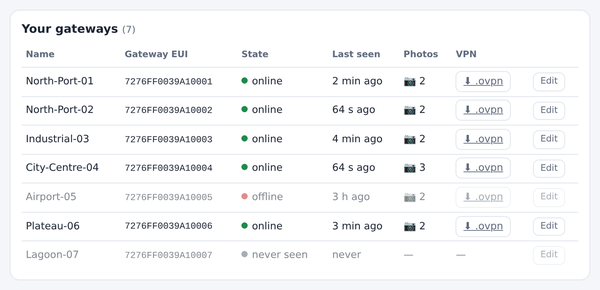
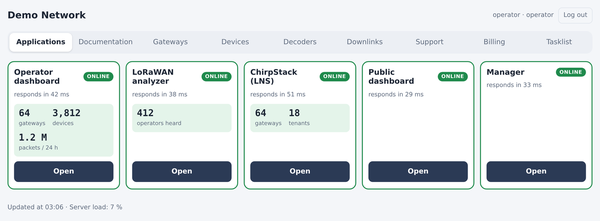
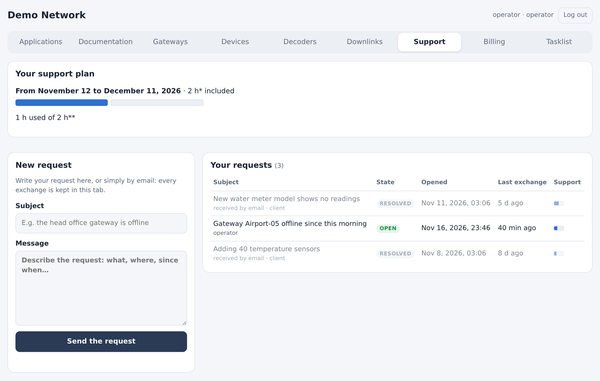
The middle option is a network server that belongs to your network alone, hosted and run by a specialist. It is what I provide as an operator platform: a dedicated ChirpStack instance with its databases, broker, data pipeline, dashboards and gateway VPN, monitored and maintained, with support included.
What changes compared with a shared platform is ownership of everything that matters. The instance is yours. The keys are exportable. The components are standard open source software, so nothing about your data or configuration is proprietary. And because the platform is the same one you could run yourself, moving it in-house later is a hand-over, not a migration.
What does not change is that someone else holds the pager. That is the point. A network that has twenty gateways and its first paying customers does not need a backend team on call; it needs the network server to stay up and someone to call when a gateway will not connect.
The trade-off is a monthly subscription, and some dependency on the provider's quality. That dependency is acceptable only if leaving is easy, which is why the exit should be written into the contract, with the source code and documentation handed over when you exercise it.
Self-Hosted
Running ChirpStack yourself, on your own hardware or a server you rent, gives you complete control and the lowest running cost at scale. There is no per-device fee at all, the data never leaves infrastructure you chose, and you can change anything. The reasons are set out in detail in why you should run your own LNS.
The cost is people. Somebody has to patch it, watch it, restore it when a disk dies, renew certificates, upgrade ChirpStack across major versions, and keep the gateway VPN and the decoders in order. For a large operator, a utility or a public body with an IT department, that is ordinary work and self-hosting is often the obvious end state. For a five-person operator in its first year, it is a distraction from selling coverage.
It is also worth being honest that self-hosting done badly is worse than any hosted option. An LNS that has never had its backups restored, sitting on one disk in a cupboard, is a single point of failure for every customer on the network. If you self-host, do it properly, or have it set up properly and trained into your team.
Choosing by Stage
The pattern that works for most operators follows the life of the network.
Proving the market. A handful of gateways, a few pilot customers, uncertainty about which use cases will pay. Either a shared platform for a strict pilot, or a dedicated operated instance from the start if you already know you will build a network, since that avoids a migration later.
Building the network. Tens of gateways, customers signing, devices arriving in hundreds and thousands. This is where a dedicated operated instance earns its place: your own server, the tools to onboard gateways and customers without engineering work, and somebody accountable for uptime while your team concentrates on coverage and sales.
Running at scale. Hundreds of gateways, an operations team, revenue that justifies in-house skills, perhaps regulatory requirements on data location. Self-hosting becomes attractive, and if the platform you have been using is the same software, you move it rather than rebuild it.
Some operators never reach the third stage and stay operated for good, which is fine. The mistake is not choosing the wrong stage; it is choosing a model that makes the next stage impossible.
Five Questions to Ask Any Provider
Whatever you choose, these questions separate a platform you can grow with from one you will eventually have to escape.
Who holds the device keys, and can I export them all today? If the answer is anything other than "you, yes", stop there.
Can my gateways point somewhere else without being touched on site? Standard protocols and a VPN or remote access you control mean yes. A proprietary gateway agent may mean no.
Can I export all historical data in a standard format? Not a CSV per device per month through a web page; the whole history, in bulk.
Is the stack proprietary? Open source components mean the skills and the software exist outside the provider. A proprietary network server means its future is tied to one company's.
What does leaving look like, and is it in the contract? A provider confident in its service writes the exit down: what is handed over, in what form, at what cost.
What I Provide
I help operators and organisations decide where their network server should live and then make it happen, in any of the three models. That includes a dedicated operator platform I host and run, built on ChirpStack and standard databases, with gateway onboarding over VPN, operator dashboards, customer access and support included, and a contractual path to self-hosting with the full source code.
For organisations ready to run it themselves, I install and harden self-hosted ChirpStack, set up monitoring and tested backups, and train the team that will own it. For networks stuck on a shared platform, I plan and run the move with both networks side by side and a rollback at every step. In every case the starting point is the same audit: who holds the keys, where the data is, and how free the gateways are to move.
Working on a LoRaWAN project?
If this article touches on something you're building, tell me about it. The first conversation is free, and you'll get an honest read on the right approach for your situation.
Book a Free ConsultationCurious what the finished thing looks like? Open the live demo dashboard