LoRaWAN Operator Platform: Run a Network Without Running the Servers
An Operator Sells Coverage, Not Servers
Becoming a LoRaWAN operator usually starts with a good reason: a city that wants smart metering, an industrial zone full of buildings to instrument, a telecom or infrastructure company that already owns rooftops and masts, or a region where nobody provides coverage yet. The business is the network. Gateways on high points, customers onboarded, devices reporting, invoices going out.
What tends to get underestimated is everything behind the gateways. A network server has to be installed, secured, monitored, backed up and upgraded. Payloads have to be decoded for every device model your customers bring. Gateways have to be reachable when they misbehave on a roof two hours away. Customers need their own access without seeing each other. And someone has to notice at three in the morning that the MQTT broker stopped, before your biggest customer does.
You can build that team, or you can start with a platform that already does all of it, dedicated to you, and keep the option to take it in-house later. Most operators should start with the second and decide about the first once the network has customers.
That is the service I provide: a complete LoRaWAN operator platform, hosted, operated and maintained for you, built on open source components you could run yourself.
What You Get: Your Own Network, Not a Shared Account
The platform is a dedicated instance. It is not a tenant on someone else's public network server, and your devices, keys and data do not sit next to another operator's. Everything below runs on infrastructure provisioned for your network alone.
A private ChirpStack network server. ChirpStack v4 with PostgreSQL, Redis and a Mosquitto MQTT broker, accepting gateways over both the Semtech UDP packet forwarder and Basics Station. It is the same network server I recommend in why you should run your own LNS, set up, tuned and kept current for you. Your end customers get their own ChirpStack accounts, each in its own tenant, so a customer manages their devices and sees their data and nobody else's.
A data pipeline that understands your devices. An ingest engine decodes every uplink with a library of payload decoders, stores the readings in a time series database built on PostgreSQL and TimescaleDB, and forwards them wherever they need to go: MQTT topics, HTTP endpoints, files. When a customer turns up with a sensor nobody has decoded before, adding its decoder is part of the service, and because the raw uplinks are kept, the readings it sent before that day are not lost either.
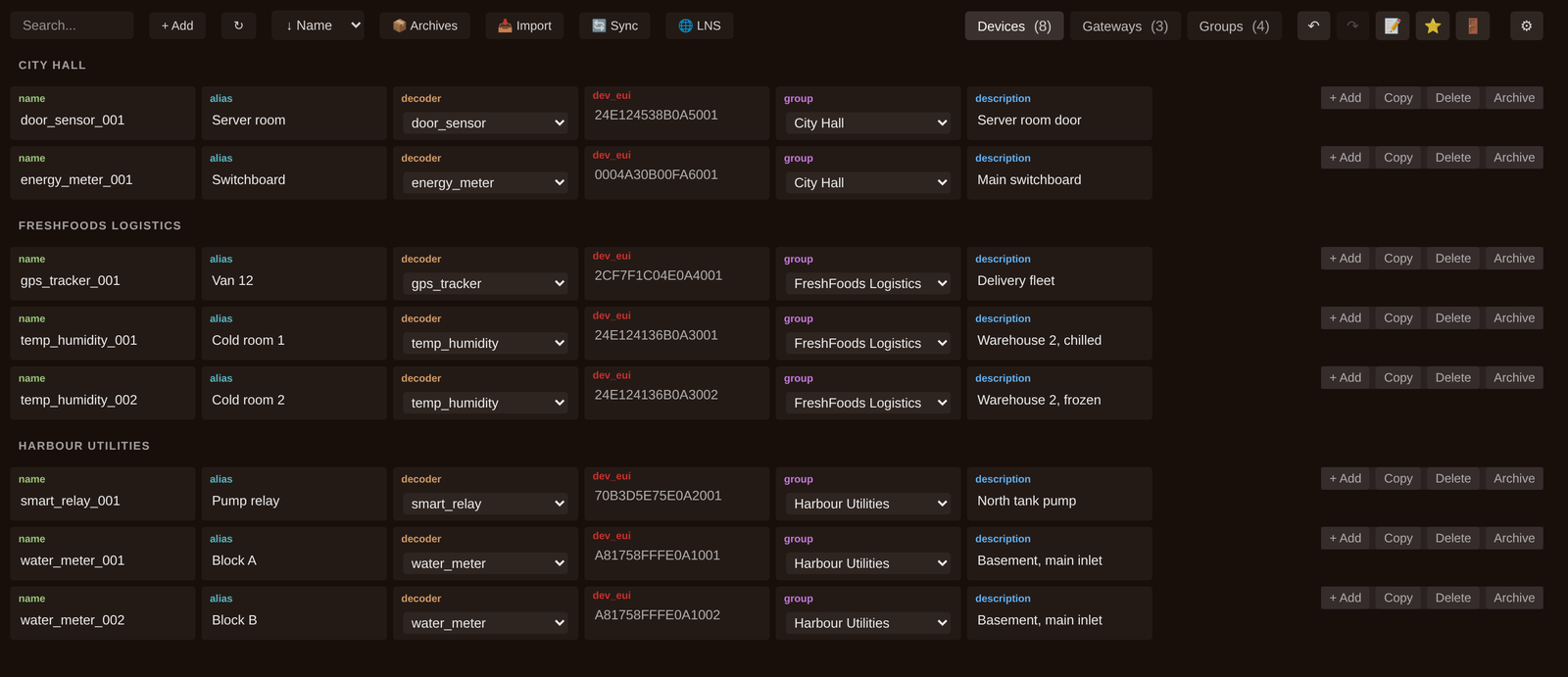
Dashboards built for running a network. The operator dashboard shows the fleet live: gateways and devices on a map, packet history, GPS tracks for trackers, and coverage computed from real uplinks on an H3 hexagonal grid, so the coverage map you show a prospect is the coverage your network actually delivers. A management interface handles devices, gateways and groups in bulk. A public dashboard, open to anyone or behind a login as you choose, is configured page by page without code, which is a useful thing to put in front of a customer who wants to see before they sign. The live demo is one.
A traffic analyzer that sees everything your gateways hear. My open source traffic analyzer is part of the platform. It shows your own traffic and everyone else's on the same spectrum: which operators are active in your area, how loaded the channels are, which of your devices are drifting. For an operator that is commercial intelligence as much as diagnostics.
One Portal for the Whole Operation
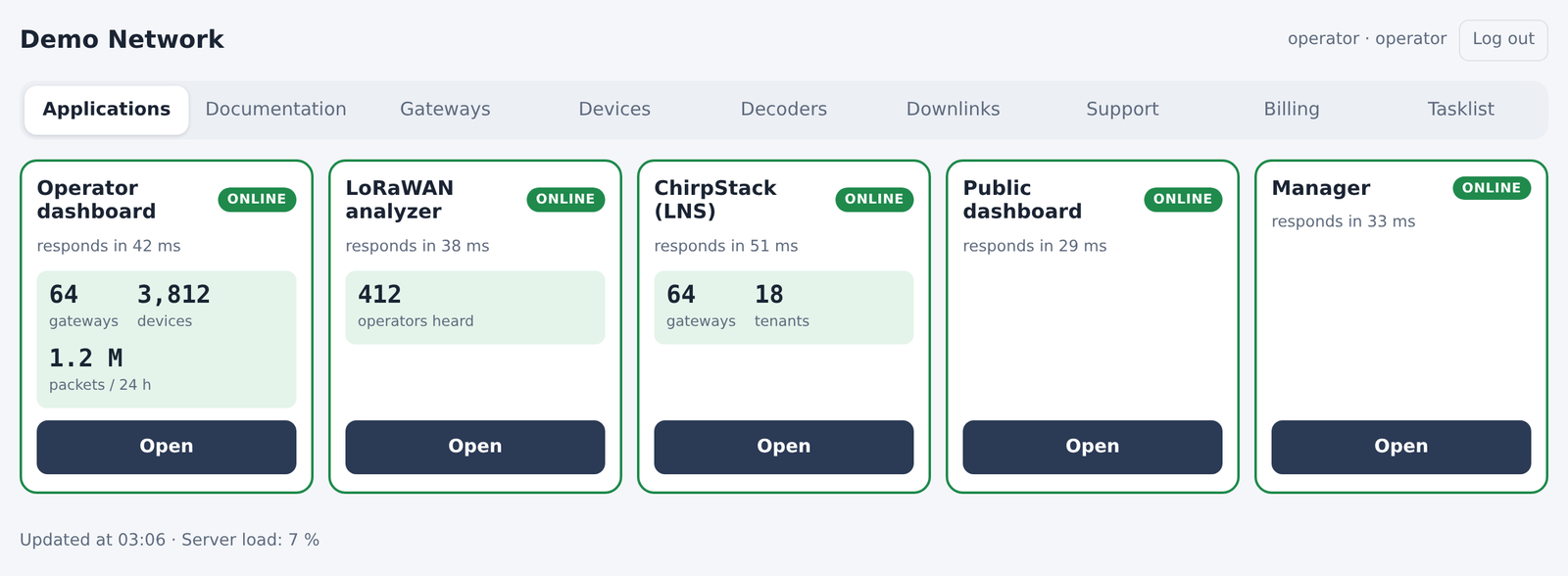
All of it sits behind a single portal with one login. Each application opens from there without signing in again, and its status is visible at a glance, so you know before you click whether something is wrong.
The portal is also where the day-to-day work of an operator happens, without opening a terminal or asking anyone.
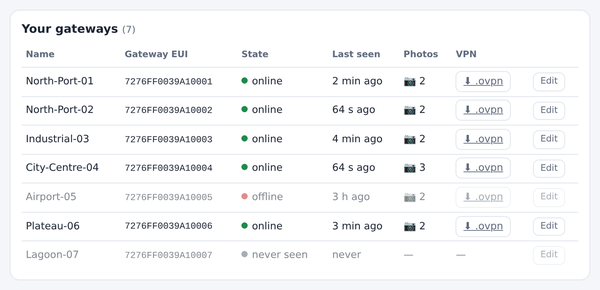
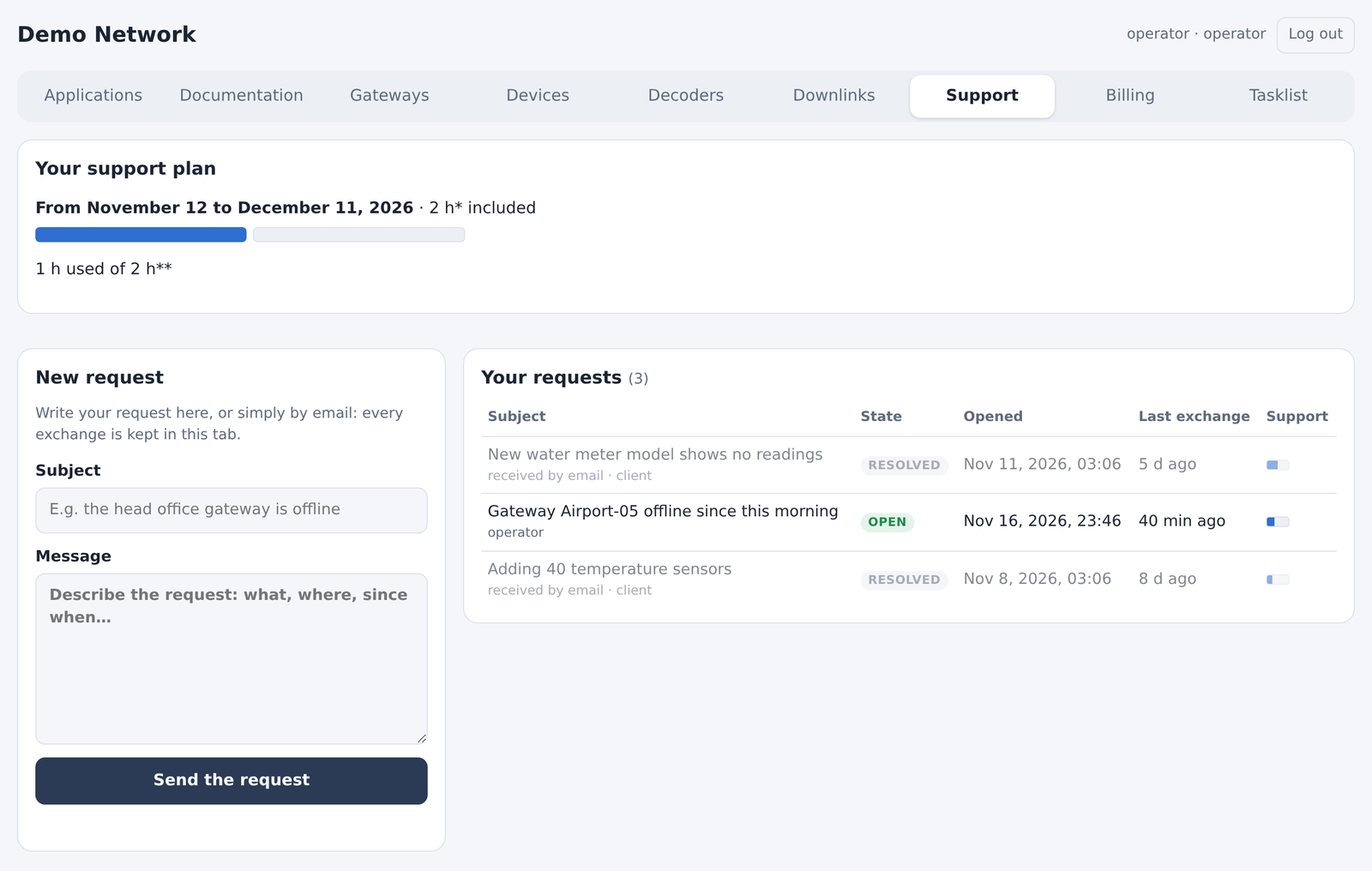
Gateways. Register a gateway with its EUI, position and installation photos, taken from a phone on site. Download the gateway's own VPN profile from the same page. See which gateways are online, which went quiet and when.
Devices. Add devices with their keys, pick the device type, and let the platform name and number them consistently. Device keys go straight to the network server, and the portal never displays a stored key again.
Decoders. Search the decoder library for a device model and see whether it is already supported before a customer buys a thousand of them.
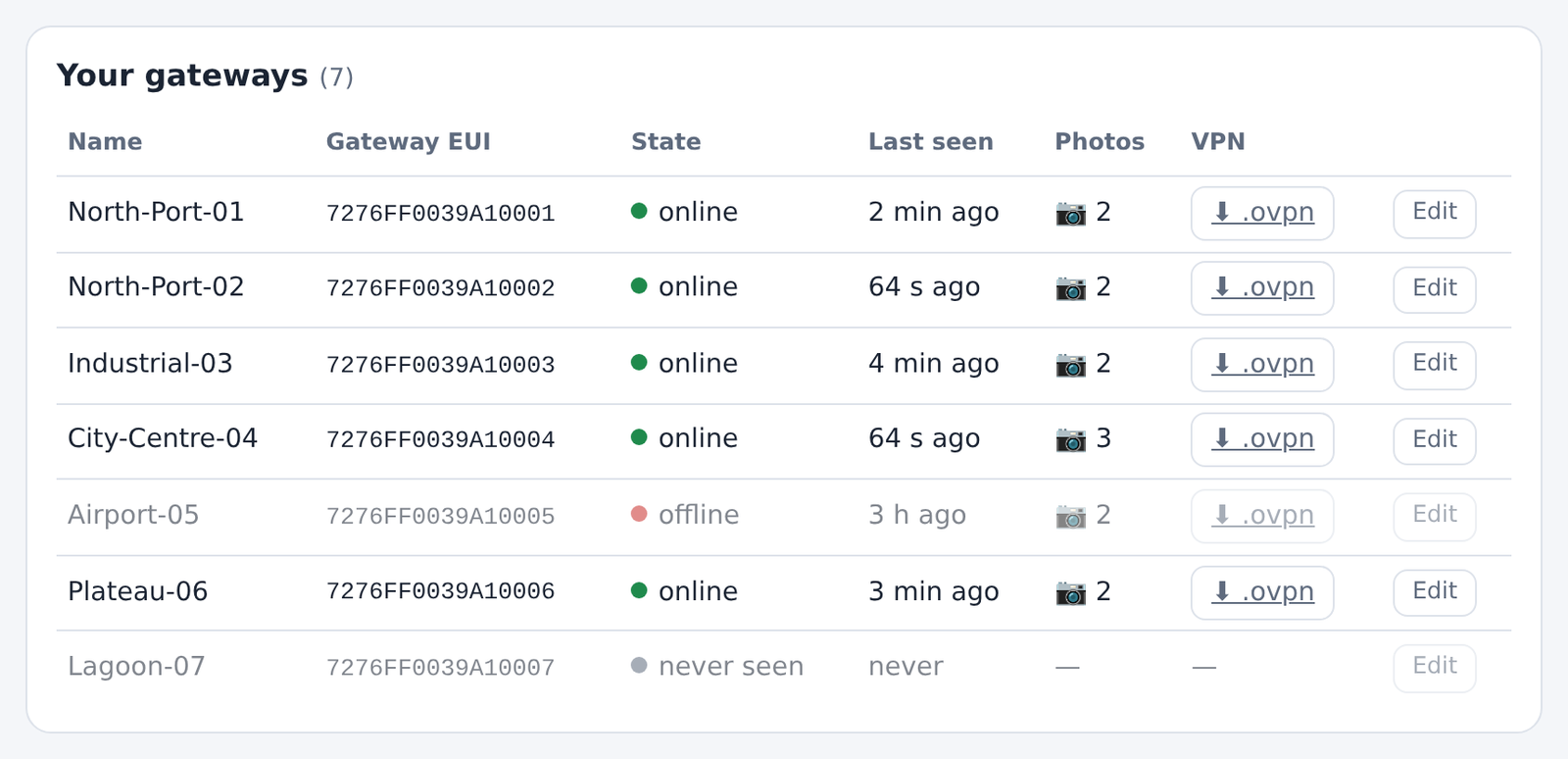
Downlinks. Send a command to one device or a whole selection, a relay to close or a reporting interval to change. Every command is described when it is sent and kept in a catalogue per device type, so the next person who needs to close a relay picks the known-good frame instead of reconstructing hex from a datasheet.
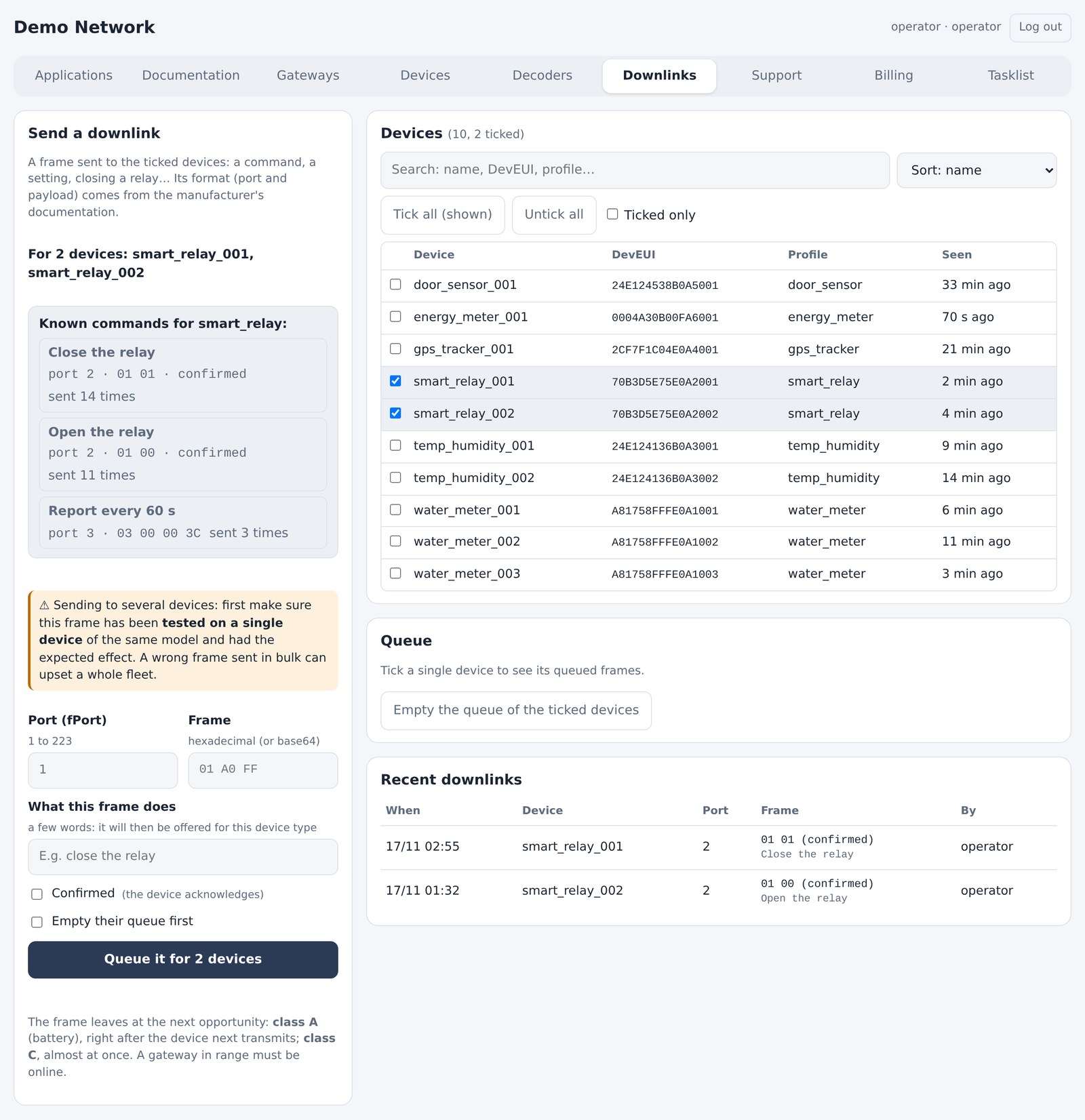
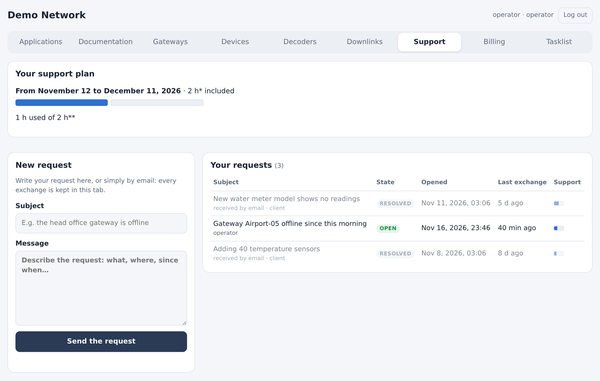
Support, tasks and billing. Support requests are tracked in the portal with the time spent on each one visible, the shared task list shows what is being worked on and what is next, and invoices are there to download. Nothing about the service lives only in someone's inbox.
Gateways You Can Reach, Wherever They Are
Gateways are where operators lose the most time. They sit behind 4G routers, carrier NAT and firewalls that nobody on site controls, and the moment one needs attention it is unreachable.
Every gateway on the platform gets its own OpenVPN profile and connects back to a VPN server dedicated to your network, over a port that gets through restrictive networks. From then on it is reachable for SSH and its web interface wherever it is, without opening anything on the local network. The gateway onboarding article explains why I use OpenVPN with a hostname for this rather than a hard-coded address: when infrastructure moves, the fleet follows on its own.
Access is segmented. Support staff reach the gateways and the platform; your field team and partners reach the gateways and nothing else; gateways cannot talk to each other. Onboarding a gateway includes the VPN, the network server registration, a check that uplinks arrive, and a look at the coverage it adds.
Operated, Not Just Installed
Software that is installed and left alone degrades. The platform is operated: monitored every day, patched, secured as a whole, with a 99.5% monthly availability commitment and outages handled within 24 hours.
Backups run every night for the network server database and the device registry, on top of a full image of the server. If you want backups that do not depend on my infrastructure at all, a backup server on your side receives its own copies, with a restore procedure that has actually been tested rather than assumed.
Support time is included every month, and it is spent on your network: a gateway that will not connect, a device that will not join, a decoder for a new sensor, a question from one of your customers. The time spent is written in each request, so what you use is never a mystery.
Already Have a Network Server?
Not every operator starts from nothing. If you already run ChirpStack, The Things Stack, Actility or Helium, the platform's parts work on their own too.
The multiplexer lets one gateway feed several network servers at once, which is how an operator can carry a customer's private LNS on shared gateways, or join a community network without dedicating hardware to it. The traffic analyzer plugs into any MQTT broker your gateways already publish to. And if you are moving off a platform that has become too expensive or too restrictive, migrating a live network without downtime is work I do regularly.
The Exit Is Part of the Offer
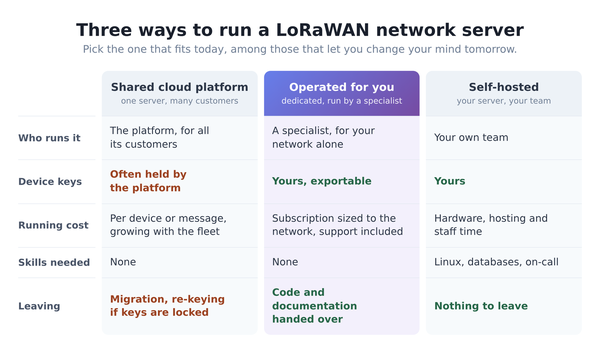
The usual argument against a hosted platform is lock-in, and it is a fair argument: I make it myself in total cost of ownership. It is why this platform is built the way it is.
Everything in it is standard. The network server is ChirpStack, the databases are PostgreSQL, TimescaleDB and MongoDB, the broker is Mosquitto, the gateways speak the same protocols they would speak to any other server. Your device keys are yours and exportable. And the offer includes a defined switch to self-hosting: at any point you can move the whole platform onto infrastructure you own, and receive the complete source code, configurations and documentation, with the time you have already spent on the hosted version taken into account.
That changes what a hosted platform is. You are not renting a network you can never leave; you are letting someone else run it while it is cheaper and simpler that way, with the keys to take it back whenever it is not.
What I Provide
A dedicated LoRaWAN operator platform, hosted and operated for you: private ChirpStack network server, data pipeline and decoders, operator and public dashboards, traffic analyzer, management tools, and a portal that ties them together with gateways, devices, downlinks, support and billing in one place.
Gateway onboarding over a dedicated VPN, with remote access to every gateway in the fleet. Customer access through their own network server accounts, and bespoke dashboards for the customers who need one. Monitoring, security, nightly backups and a monthly availability commitment, with support time included and visible.
Consulting around it when you need it: coverage planning, gateway selection and siting, device choice for a new use case, and training for the team that will grow the network. The subscription scales with the number of gateways and devices you run, and the path to owning the whole thing outright is written into the offer from the first day.
Working on a LoRaWAN project?
If this article touches on something you're building, tell me about it. The first conversation is free, and you'll get an honest read on the right approach for your situation.
Book a Free ConsultationCurious what the finished thing looks like? Open the live demo dashboard